
Law Office / Contingent fee (New Jersey)
Contingent Fee Calculator and Closing Statement (New Jersey)
The fee on a New Jersey tort recovery, tier by tier under R. 1:21-7(c), and the signed closing statement the client gets at the end.
One matter, start to finish, in one workbook. For New Jersey lawyers who take tort cases on a contingent fee, and the paralegals who close the file. Type the gross recovery and each cost and lien. The sheet takes the costs of the claim off first, works the net sum through the four tiers, and lays out the closing statement for you to sign.
Works in Excel 2016 or later, Google Sheets and LibreOffice. No macros.
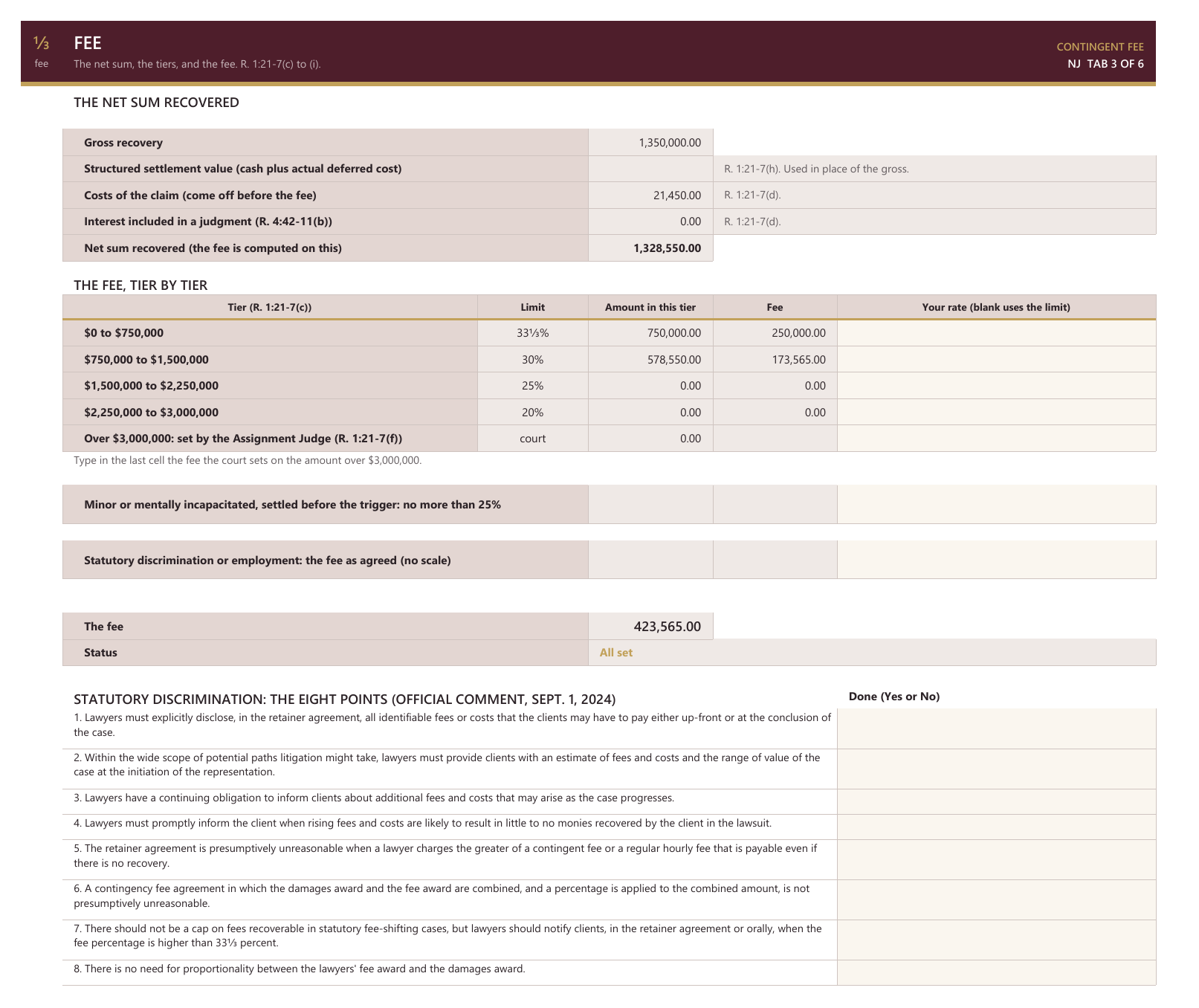
Scroll the sheet sideways to see all of it.
How the fee is worked out
First the net sum. R. 1:21-7(d) puts the fee on what is left after the costs of the claim, whether the firm or the client paid them, and after any interest included in a judgment. Liens and medical bills don't come off first. Disbursements marks each cost with whether it comes off before the fee.
Then the four tiers. 33⅓% of the first $750,000, then 30%, 25% and 20% of each next $750,000. Type a lower rate for any tier, or leave it blank for the limit. Above $3,000,000 the sheet prints no percentage: it shows the amount over the line and takes the fee the court sets.
Then the closing statement. The outcome, the deductions, the fee tier by tier and the net to the client, with lines to sign and date, as R. 1:21-7(g) and RPC 1.5(c) describe.
The sample matternet sum 1,328,550.00
The fee423,565.00
- Gross recovery1,350,000.00
- Less costs of the claim-21,450.00
- Net sum recovered1,328,550.00
- Fee-423,565.00
- Less liens paid from the recovery-42,000.00
- Net to the client862,985.00
The sample settlement, with three costs of the claim advanced by the firm and a medical lien paid from the recovery. The firm, the client and the amounts are made up.
What the sheet works out, and what it leaves to you
| What | What the sheet does | The Check note you might see |
|---|---|---|
| The net sum | Takes the costs of the claim off the gross, whoever paid them, and any judgment interest you type. Liens stay out of it and come off after the fee. | Check: say who paid it |
| The four tiers | Works the net sum through 33⅓%, 30%, 25% and 20% at your rates. A blank rate uses the limit. | Check: a rate is above the limit (R. 1:21-7(c)) |
| Above $3,000,000 | Shows the amount over the line and takes the fee the court sets, which you type in. It never prints a percentage there. | Check: type the fee the court set on the amount over $3,000,000 |
| A minor client | If the client was a minor or mentally incapacitated when the agreement was made and it settled before the trigger, the fee is no more than 25% of the net sum. | Check: say whether it settled before the trigger |
| Several clients | Works the fee on the aggregate and splits it in proportion to each share. The costs and liens each client bears are yours to type, and they should add up to the Closing Statement's. | Check: the costs and liens allocated do not add up to those on the Closing Statement |
| Statutory discrimination | Sets the scale aside, takes the fee as agreed, and lists the eight points from the 2024 comment for you to mark. | Check: mark each of the eight points Yes |
| Before you start | Asks you to mark that you advised the client of the right to a non-contingent fee, and that the agreement is in writing. | Check: mark that you advised the client of a non-contingent fee |
Every Check note describes what you typed. None of them decides anything.
The rules it quotes
The Rules tab quotes 12 passages of R. 1:21-7 and RPC 1.5 word for word, with the web address on njcourts.gov and the date each was read. Here they are in plain words.
| What | In plain words | Source |
|---|---|---|
| A non-contingent option first | Before a contingent fee agreement, the client is told of the right to hire the attorney for the value of the services instead. | R. 1:21-7(b) |
| The limits | 33⅓% of the first $750,000, 30% of the next $750,000, 25% of the next and 20% of the next, in a tort matter. Statutory discrimination and employment claims are excluded. | R. 1:21-7(c) |
| A minor client | For a client who was a minor or mentally incapacitated when the agreement was made, a settlement before the trigger carries a fee of no more than 25%. | R. 1:21-7(c) |
| The net sum | The fee is worked on what is left after the costs of the claim and judgment interest. Liens and medical bills need not come off first. | R. 1:21-7(d) |
| Below the limits | The scale sets the most a fee can be. A lower fee is always open. | R. 1:21-7(e) |
| Above the scale | On written notice to the client, the attorney may apply to the Assignment Judge, who sets the fee. | R. 1:21-7(f) |
| In writing, and a closing statement | The agreement is in writing, signed by both, with a copy to the client, and the client gets a signed closing statement at the end. | R. 1:21-7(g); RPC 1.5(c) |
| Structured settlements | The value is the cash paid at the settlement plus what the deferred payments actually cost the party paying them. | R. 1:21-7(h) |
| Several clients | The fee is worked on all the recoveries together and charged to each client in proportion. | R. 1:21-7(i) |
| Statutory discrimination | The eight points the Court set out in Balducci v. Cige, set out on the Fee tab word for word. | Comment to R. 1:21-7, Sept. 1, 2024 |
| Where a contingent fee is not used | Domestic relations matters tied to a divorce, alimony or support, and the defence of a criminal case. | RPC 1.5(d) |
The sheet never judges a fee. You decide the fee and sign the statement. Rules change, so check the current text on njcourts.gov before relying on it.
What's in the file
Six tabs, each under the wine band with a gold one-third sign over "fee". Cream cells are yours to type in. Grey cells are formulas: leave them alone and they stay right.
- 1 Start HereThe firm, the matter, the kind of matter, the gross recovery, a structured settlement, and the advice and written agreement you mark.
- 2 DisbursementsEvery cost and lien, what it was and who paid it. Costs of the claim come off before the fee; liens come off after.
- 3 FeeThe net sum, the four tiers at your rates or the limit, the minor and statutory cases, and the line over $3,000,000 left to the court.
- 4 ClientsFor more than one client on the same facts: the fee on the aggregate split by share, less the costs and liens you allocate to each.
- 5 Closing StatementThe page you sign and give the client: the outcome, the deductions, the fee tier by tier and the net to the client.
- 6 RulesR. 1:21-7 and RPC 1.5, word for word, with the web address and the date read.
Yours to type inWorked out by the sheetOnly for a Check noteAll set, and the rule under each bandThe band on every tab
Every figure was checked before it went on sale. LibreOffice recalculated the workbook, and a separate program read it back and compared it with figures worked out by hand: the net sum, each tier, the fee, every line of the closing statement, the net to the client, and the same net on the Clients tab.
Then nine test copies each tried one case: recoveries of 600,000, 1,200,000, 2,500,000 and 3,500,000, a minor client settled before the trigger, a structured settlement, two clients sharing one recovery, a statutory discrimination matter, and a rate above the limit. Each gave the figure worked out by hand, or the Check note it should.
Questions
Does it work in Google Sheets?
Yes. Upload the file to Google Drive, then open it. Every formula is a plain one, so it works there too. It also opens in Excel 2016 and later and LibreOffice Calc, with no macros and no add-ons.
Does it tell me the fee is proper?
No. It works out the limits and the figures from what you typed. You decide the fee and sign the statement, and the Rules tab quotes the text so you can read it yourself.
Why don't liens come off before the fee?
R. 1:21-7(d) says no deduction need be made for liens, assignments or claims for medical care before the fee is worked out. The sheet takes them off the client's share after the fee, and the closing statement shows both.
What happens above $3,000,000?
The sheet shows the amount over $3,000,000 and asks for the fee the court set on it. It never prints a percentage above that line.
Can it handle a structured settlement?
Yes. Mark it on Start Here and type the cash paid at the settlement and the actual cost of the deferred payments. Their sum takes the place of the gross.
What if there are several clients?
Type each client's share on the Clients tab, and the costs and liens to take from it. The fee is worked on the total and split in proportion to each share. When the costs and liens you allocate add up, the nets total the Closing Statement's net to the client; when they don't, a Check note says so.
Is it only for New Jersey?
It was built around New Jersey's R. 1:21-7 and RPC 1.5, which the Rules tab quotes. Other states set their limits differently.
Is there a subscription?
No. It's a one-time download, for personal use or use within one firm per purchase. You keep the file.
What if something doesn't work?
Email [email protected] and include your order email. Typical response within 2 business days.
Please note
- Digital download. Nothing is shipped.
- No macros, no add-ons, no subscription.
- An organiser, not legal advice. The sheet never judges a fee: it works out the limits and the figures from what you typed. The Rules tab quotes the text for reference, and every Check note describes what you typed; none of them decides anything.
- Not connected with the State of New Jersey, the New Jersey courts, the Office of Attorney Ethics or any bar association.
- The file holds client matters: keep it password-protected.
- The sample firm, client and amounts are made up.
License: personal use, or use within one firm per purchase. No resale or sharing of the file.
The fee, then the statement
A one-time download, for personal use or use within one firm per purchase. Digital file, nothing shipped, no subscription.
Sold through Gumroad. Questions before you buy: [email protected]
Excel 2016 or later, Google Sheets, LibreOffice
More from the Law Office: Attorney Trust Account Reconciliation Workbook (New Jersey), Law Firm Closed File Retention and Destruction Log (New York), Case Deadline and Discovery Tracker, Billable Hours and Invoice Log, Client Trust Account Ledger (New York), Executor Estate Inventory and Ledger, Medical Records Request and Chronology Log, Settlement Disbursement Sheet (New York), Law Firm Client Intake and Conflict Check Log, Successor Trustee Accounting Ledger, Deposition Tracker and Summary Log, Power of Attorney Agent Ledger and Record Log (New York)